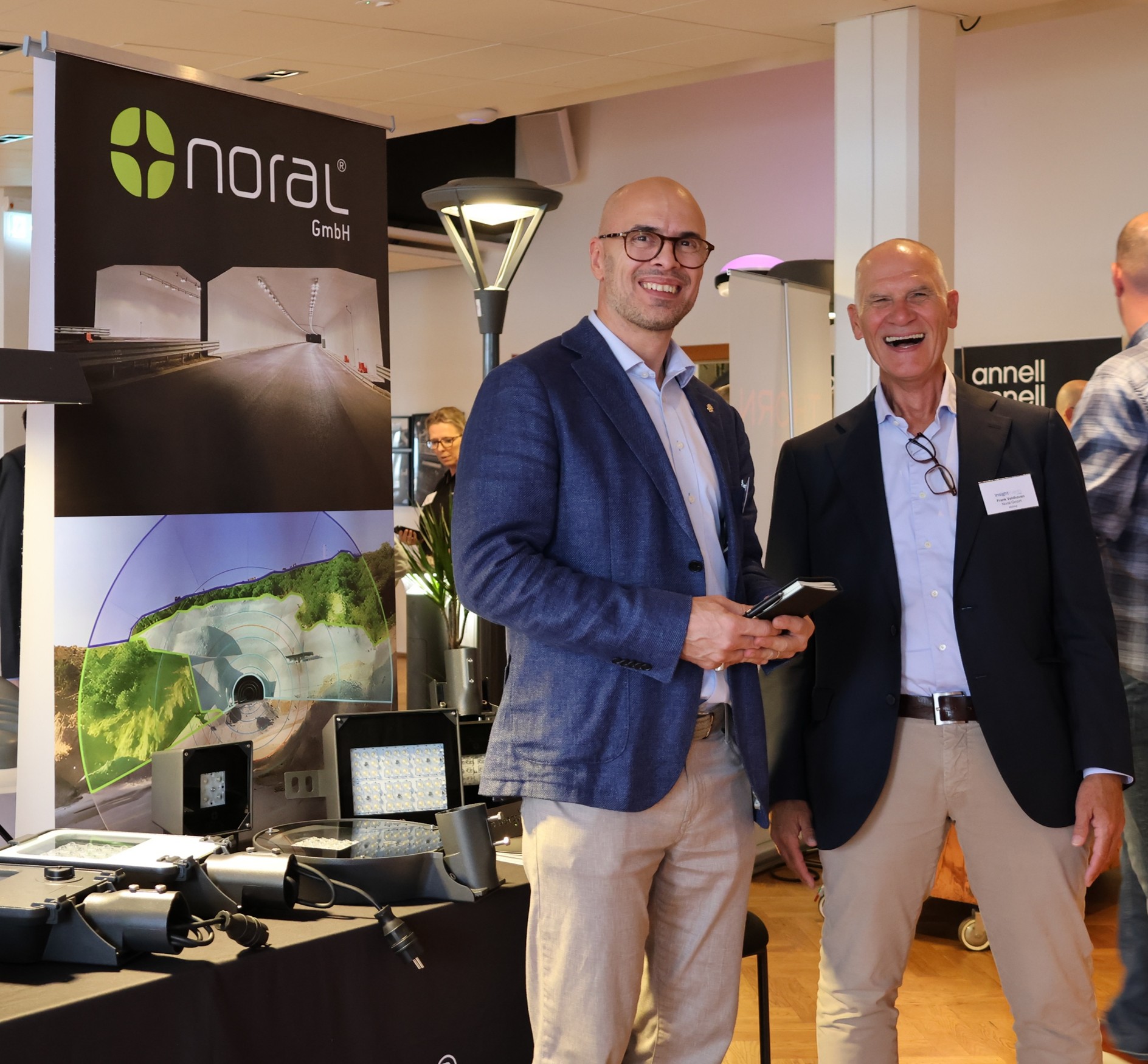
 With a history dating back to 1948, Noral has built its reputation on high-quality luminaires designed for Nordic conditions. At Gatubelysningsforum 2026, we spoke with Timo G. Bergström, who also took part as a speaker at the conference, about Noral’s heritage, the importance of long-lasting products and how LED and lighting control technologies are opening up new possibilities for more sustainable and adaptable street lighting.
Timo, can you tell us about Noral and what you do?
Noral is a classic Norwegian lighting brand with a history dating back to 1948. Noral’s trademark has always been the outstanding quality of its aluminium and its coating, which is specifically designed for Nordic conditions – conditions that differ significantly from those in Central Europe.
In the beginning, Noral produced lanterns for a variety of environments, including churches, cemeteries and historic urban settings. The quality of these lanterns was remarkable. Even after 15 or 20 years, they could look just as good as they did only a few days after installation.
That heritage is still very much part of the Noral we are today. Noral is a Norwegian brand, but today it is owned by a major Turkish lighting manufacturer. Our central European function is based in Germany, so it is a very international organisation.
Noral’s fundamental idea is to be a premium brand that really goes beyond the norm. What sets Noral apart in the market is that we manufacture everything ourselves. We cast and coat the luminaire housings in our own factory. We manufacture our own circuit boards and lenses, as well as the seals used in the luminaires. We also manufacture our own drivers in one of our factories.
This means that our luminaires are not simply assembled from standard components. Instead, we manufacture all the components specifically for the luminaire and for the conditions in which it will be installed, and operated. This is what we call “Beyond the norm.”
What are you most looking forward to discussing with the participants at this year’s Gatubelysningsforum?
I would say sustainability – in practice. That is closely connected to the quality of Noral’s aluminium and coatings. We want to highlight that these are products designed to do their job for a long time. Choose the right product and you can minimize both cost and environmental impact over its lifetime.
I hope the discussion will focus much more on quality. In a way, that brings us back to our roots. That is something we hope we will have the opportunity to talk about.
What is Noral’s focus going forward?
Our focus is to re-establish this fantastic brand across the Nordic market and bring Noral back to where it once was – as one of the leading brands in technical premium lighting for street and outdoor applications.
How would you say technology has changed over the past five years?
Oh, how much time do we have? On one hand, LED technology has matured. It was somewhat inconsistent in the beginning. But another important change is that the focus used to be very much on the LED itself. Today, much of that focus has shifted towards the driver and the control electronics around it – essentially the brain of the luminaire.
The way luminaires communicate and how they can deliver different light levels in different scenarios has really changed. That has been a major development. It is a development that Noral has adapted to extremely well.
What do you wish more people would know about street lighting?
I would like people outside the industry to be aware that it is actually possible to control lighting based on presence – to adjust lightlevels depending on whether or not people are present.
It is also possible to change the colour temperature of the light. And, not least, there has been a lot of discussion about how we can work even more with colour temperature and spectral composition to minimize disruption to nocturnal animals.
I wish more people were aware of these possibilities. If they were, they would also be able to set much stronger requirements for these solutions than they do today.